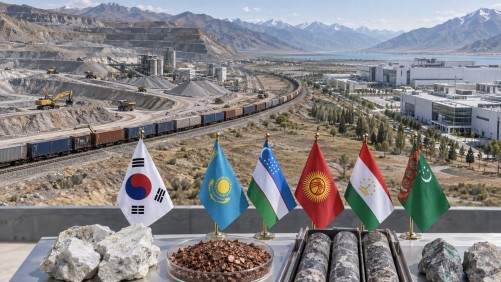
South Korea’s expanded cooperation with Central Asian countries on critical minerals is set to significantly impact its key industries, including automotive, electronics, battery, and energy. This development comes as part of a broader initiative to ensure reliable supply chains by tapping into Central Asia’s rich mineral resources.
The recent South Korea–Central Asia summit in Seoul marked a pivotal step in this collaboration, resulting in over 70 agreements and memorandums. Both regions agreed to convene the summit biennially and establish a C5+1 forum for industry ministers, underscoring the importance of this partnership. Critical minerals emerged as a focal point, with South Korea aiming to leverage its expertise in exploration, processing, and advanced manufacturing to enhance local processing capabilities in Central Asia.
Central Asian countries, including Uzbekistan, Kazakhstan, Kyrgyzstan, and Tajikistan, are eager to develop their mineral processing industries and move beyond merely exporting raw materials. Uzbekistan has floated the idea of an investment alliance for critical minerals, while Kazakhstan is exploring cooperation in rare metals, nuclear and clean energy, artificial intelligence, and infrastructure. Both countries are keen to deepen their strategic partnerships with South Korea.
In addition to minerals like antimony and tungsten, Kyrgyzstan and Tajikistan are also seeking South Korean collaboration in various sectors. The South Korean government is responding by expanding its role in transportation and infrastructure projects across the region, reflecting a growing presence that rivals efforts by China, the United States, the European Union, and Japan to secure access to Central Asia’s critical resources.
This collaborative framework aims to cover the entire supply chain, from identifying mineral deposits and initiating mining operations to processing and producing high-value goods. Moreover, rare metals research and training centers are being established to support these endeavors, promising a more integrated and sustainable approach to mineral resource management.
The next South Korea–Central Asia summit is planned for 2028 in Kazakhstan, promising to build on the agreements made in Seoul and further solidify the cooperation that is crucial for both South Korea and Central Asia in the global race for critical minerals.