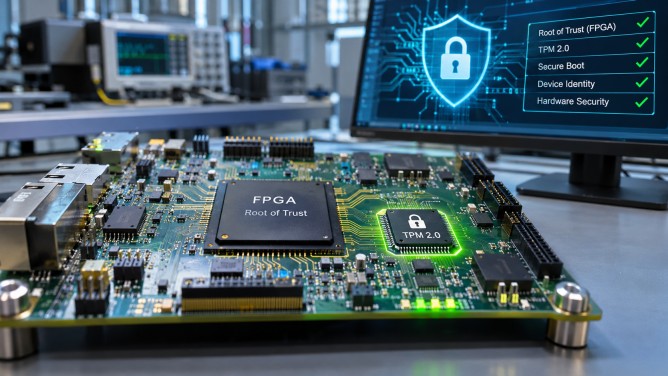
SecEdge, Inc. has introduced its SEC-TPM™ firmware-based Trusted Platform Module (TPM) as a TPM 2.0 option for Lattice Semiconductor’s Root of Trust FPGAs. This integration enables server designers to run TPM 2.0 on the same programmable device that protects, detects, and recovers platform firmware, simplifying security architecture and reducing hardware needs in hyperscale data centers.
The integration is available for the Lattice MachXO5™-NX, Lattice Mach™-N2, and Lattice Avant™ FPGA families. Lattice’s Root of Trust FPGAs provide hardware-based security features like NIST SP 800-193 Platform Firmware Resiliency (PFR), CNSA 2.0-aligned post-quantum cryptography, and SPDM-based attestation for Open Compute Project (OCP) architectures. By extending this framework with TPM 2.0 functionality, SEC-TPM eliminates the need for a separate discrete TPM chip.
The collaboration supports several security functions, such as measured boot, secure key storage, and host attestation. SecEdge CEO Sami Nassar stated that the solution meets the demand for standard TPM 2.0 compatibility without adding extra chips to server boards. Mamta Gupta, vice president of Compute and Communications Business at Lattice Semiconductor, emphasized the importance of providing customers with flexible security design options, enhancing software interoperability, and reducing potential attack surfaces.
This development could benefit hyperscale data center operators and server manufacturers by simplifying board layouts and decreasing bill of materials (BOM) costs. Combining firmware protection and TPM functionality within a single FPGA may also expedite boot processes and reduce the number of individual security components needed. The programmable nature of FPGAs allows platforms to adapt to evolving security requirements, a crucial capability as data center infrastructure faces increasingly complex cybersecurity challenges.
Offering another option for organizations seeking standard security integrations, SEC-TPM is available across three Lattice FPGA families, providing designers flexibility when developing secure computing platforms. As the demand for trusted hardware architectures increases, the integration of firmware resilience, attestation, and TPM 2.0 functionality within a single device could significantly influence future data center security designs.
ABOUT SecEdge
SecEdge™ is a pioneer in AI infrastructure security, delivering the trust foundation for the AI era. The SecEdge AI-TRUST™ Platform provides chip-to-cloud AI model protection, provenance, and lifecycle management, enabling organizations to secure and govern AI across devices, edge systems, and cloud environments. Its award-winning technologies establish trust in AI-enabled devices while simplifying compliance with evolving industry and government regulations. As AI becomes critical infrastructure, SecEdge is making trusted AI a reality.
Learn more at www.secedge.com or email [email protected].
Lattice Semiconductor Corporation, Lattice Semiconductor (& design), AMI, and specific product designations are either registered trademarks or trademarks of Lattice Semiconductor Corporation or its subsidiaries in the United States and/or other countries. The use of the word “partner” does not imply a legal partnership between Lattice and any other entity.
Jennifer Walken
SecEdge, Inc.
[email protected]
Legal Disclaimer:
The information contained in this article has been provided by independent third-party contributors, clients, or content partners. We do not independently verify the accuracy, completeness, legality, ownership, licensing, or reliability of submitted content, including text, images, videos, trademarks, or other media materials. The submitting party is solely responsible for ensuring that all content, including images and media assets, complies with applicable copyright, trademark, licensing, and intellectual property laws. We disclaim liability for any unauthorized use of copyrighted or proprietary materials by third parties. If you believe that any content published on this platform infringes your intellectual property rights, kindly contact the author above for prompt review and resolution.